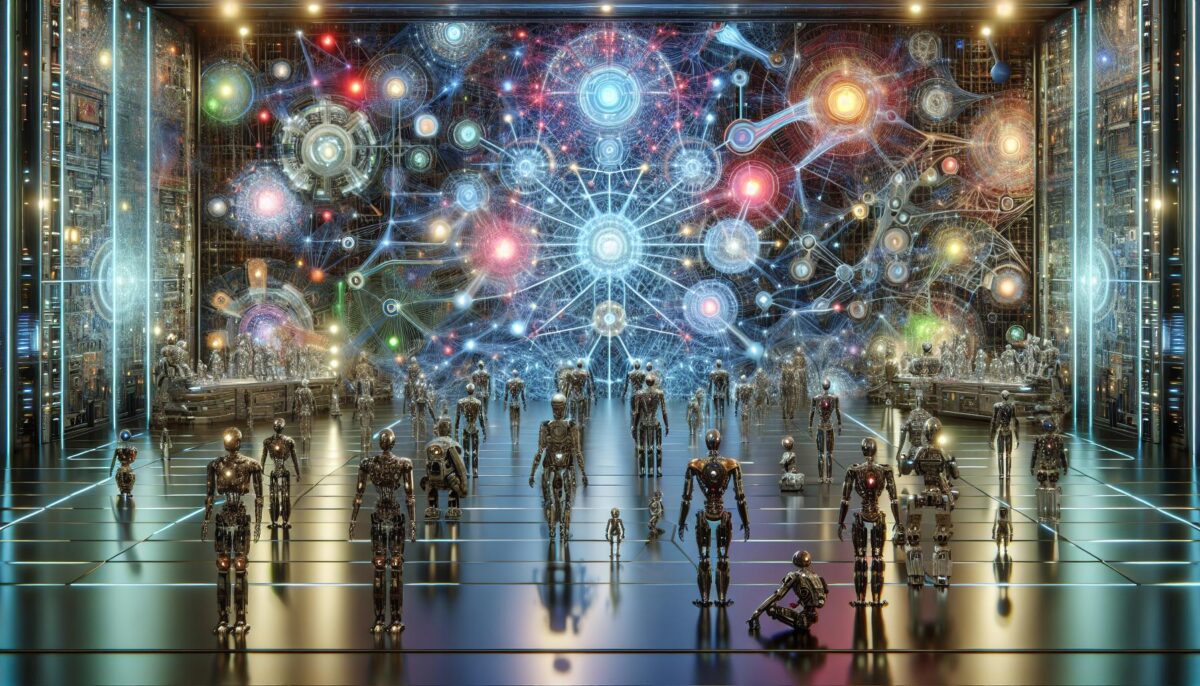
Artificial Intelligence, popularly known as AI, is the science of making machines capable of performing tasks that would typically require human intelligence. AI is often perceived as a complex field, but in reality, once we dive into it, we find ourselves intrigued by its exciting possibilities.
AI Usage
AI has a broad spectrum of uses and is slowly changing the dynamics of several industries. For instance, in healthcare, AI is used to predict diseases or analyze medical images. In finance, it’s used to predict market trends and in automobiles, it’s used to facilitate self-driving cars.
Moreover, AI is the backbone of personal voice assistants like Siri, Alexa, and Google Assistant, which we often use in our daily lives. AI is also used in recommendation systems which platforms like Netflix and Amazon utilise to personalize the user experience.
Advancement in AI
AI technology has been advancing rapidly. It allows machines not only to perform complex tasks efficiently but to learn from experience. This is known as Machine Learning. Another advancement is Deep Learning, a subset of Machine Learning, which makes sense of data with a logical structure similar to human neural networks.
Popular AI tools
There are several tools available that make AI accessible to both study and develop on. These include frameworks like TensorFlow, Keras, and PyTorch which help in the development of AI models. Programming languages like Python and R play a significant role in AI development due to their simplicity and extensive support for statistical and mathematical operations.
Future Prospects
As we move towards a more digitized world, the role of AI is becoming more prominent. AI has the potential to automate many manual tasks, making work more efficient and accurate. Moreover, future AI is anticipated to open new avenues in predictive sciences, enabling us to have a better forecast in fields such as climatology and disease control.
AI in advanced robotics can help in areas like rescue operations, where human lives are at risk. Smart homes, where devices communicate with each other and increase efficiency and comfort, are another exciting application of AI we can expect in the future.
In summary, AI is neither complicated nor something to fear. Instead, it’s an area full of potential to make our lives easier and more efficient. It’s about learning from and understanding the world around us and using that knowledge to improve and automate different aspects of life. It’s a vast field with endless opportunities, and the future holds even more promises.
For beginners exploring AI, the potential and scope indeed seem to be intriguing. Your journey in understanding and applying AI will be enriched with continuous learning and fascination at every step. Happy exploring!